Best time to visit Cairns: weather, seasons and tropical conditions
There is no single best month to visit Cairns. The useful choice is between different tropical conditions: a generally warmer, wetter part of the year and a generally drier, milder part.
January to March carry the highest historical monthly rainfall at Cairns Aero, while the middle of the year is typically cooler and much drier. That pattern can guide the kind of holiday you plan, but it cannot forecast an individual day or season.
Cairns is also within Australia's tropical cyclone region. The official cyclone season runs from 1 November to 30 April, but that does not mean a cyclone will affect a particular trip. Current Bureau of Meteorology forecasts and warnings—not long-term averages—are the right tools close to travel.
Cairns Travel Guide
Weather & best time
This article is part of the Cairns Travel Guide.
Seasonal overview
Cairns weather at a glance
Area
Typical climate character
May suit travellers who…
What to remember
December to February
The warmest part of the annual cycle, with high historical rainfall and humidity
Want tropical warmth and can keep plans flexible around current conditions
It is also within cyclone season; climate averages cannot predict a trip
March to May
A transition from the wettest months towards lower rainfall and milder temperatures
Prefer a shoulder-period decision rather than choosing the middle of either broad season
March remains historically wet; the change is gradual, not a fixed switch
June to August
The mildest period, with the lowest historical rainfall totals and cooler nights
Put drier, milder conditions high on the list
Drier does not mean rain-free, including for coast and rainforest plans
September to November
A transition towards warmer conditions and rising late-year rainfall
Are comfortable with increasing warmth while keeping dates flexible
November enters the official cyclone season and is not identical to September
December to February
Typical climate character
The warmest part of the annual cycle, with high historical rainfall and humidity
May suit travellers who…
Want tropical warmth and can keep plans flexible around current conditions
What to remember
It is also within cyclone season; climate averages cannot predict a trip
March to May
Typical climate character
A transition from the wettest months towards lower rainfall and milder temperatures
May suit travellers who…
Prefer a shoulder-period decision rather than choosing the middle of either broad season
What to remember
March remains historically wet; the change is gradual, not a fixed switch
June to August
Typical climate character
The mildest period, with the lowest historical rainfall totals and cooler nights
May suit travellers who…
Put drier, milder conditions high on the list
What to remember
Drier does not mean rain-free, including for coast and rainforest plans
September to November
Typical climate character
A transition towards warmer conditions and rising late-year rainfall
May suit travellers who…
Are comfortable with increasing warmth while keeping dates flexible
What to remember
November enters the official cyclone season and is not identical to September
This is a planning comparison, not a ranking. Your tolerance for humidity, rain and changing outdoor plans matters more than finding a supposedly perfect month.
Wet season and drier season
Cairns has a tropical climate with hot, humid summers and milder, drier winters. The Bureau describes January to March as the period when most rain falls. It also identifies May to October with the trade-wind period, when showers can still reach the coast.
That is why the labels need care. The wetter part of the year does not mean rain falls continuously every day. The drier part does not promise blue skies or dry ground for every activity. Monthly averages combine many years and cannot show how rain will be distributed during your stay.
Think of the seasons as a change in likelihood and travel style. Warmer, wetter months call for more flexibility around weather-sensitive plans. Drier, milder months reduce the historical rainfall burden, but current forecasts, park alerts and provider advice still matter.
Cairns temperatures and rainfall
The numerical comparison below uses one location throughout: Bureau of Meteorology Cairns Aero station 031011, at 16.87°S, 145.75°E and 2 metres elevation.
The source is Bureau of Meteorology product IDCJCM0027, prepared on 15 October 2026.
Mean maximum and minimum temperatures and days with at least 1 mm of rain use an all-years record from 1942–2026 with 84 available years. Mean rainfall also covers 1942–2026, with 83 available years. These are historical monthly means, not a 1991–2020 climate-normal series and not a forecast.
Month
Mean max
Mean min
Mean rainfall
Days ≥ 1 mm
Planning context
January
31.5°C
23.8°C
404.8 mm
15.8
Hot, humid and historically very wet
February
31.3°C
23.8°C
436.1 mm
16.1
Highest monthly mean rainfall in this record
March
30.7°C
23.2°C
424.3 mm
16.1
Still within the wettest historical cluster
April
29.4°C
21.8°C
201.7 mm
14.6
Rainfall eases, but remains well above mid-year levels
May
27.7°C
20.0°C
91.6 mm
10.5
Clear movement towards milder, drier conditions
June
26.2°C
18.0°C
45.7 mm
7.0
Mild days and cooler nights in the historical record
July
25.9°C
17.2°C
33.2 mm
5.7
Lowest mean maximum and minimum temperatures
August
26.7°C
17.4°C
26.9 mm
4.9
Lowest monthly mean rainfall and fewest rain days
September
28.2°C
18.8°C
34.8 mm
5.0
Temperatures begin rising while rainfall remains relatively low
October
29.7°C
20.7°C
47.2 mm
5.7
Warmer late-drier-season context
November
30.8°C
22.4°C
87.9 mm
7.8
Warmer transition into cyclone-season planning
December
31.5°C
23.4°C
193.8 mm
10.7
Hotter and wetter than the middle of the year
January
Mean max
31.5°C
Mean min
23.8°C
Mean rainfall
404.8 mm
Days ≥ 1 mm
15.8
Planning context
Hot, humid and historically very wet
February
Mean max
31.3°C
Mean min
23.8°C
Mean rainfall
436.1 mm
Days ≥ 1 mm
16.1
Planning context
Highest monthly mean rainfall in this record
March
Mean max
30.7°C
Mean min
23.2°C
Mean rainfall
424.3 mm
Days ≥ 1 mm
16.1
Planning context
Still within the wettest historical cluster
April
Mean max
29.4°C
Mean min
21.8°C
Mean rainfall
201.7 mm
Days ≥ 1 mm
14.6
Planning context
Rainfall eases, but remains well above mid-year levels
May
Mean max
27.7°C
Mean min
20.0°C
Mean rainfall
91.6 mm
Days ≥ 1 mm
10.5
Planning context
Clear movement towards milder, drier conditions
June
Mean max
26.2°C
Mean min
18.0°C
Mean rainfall
45.7 mm
Days ≥ 1 mm
7.0
Planning context
Mild days and cooler nights in the historical record
July
Mean max
25.9°C
Mean min
17.2°C
Mean rainfall
33.2 mm
Days ≥ 1 mm
5.7
Planning context
Lowest mean maximum and minimum temperatures
August
Mean max
26.7°C
Mean min
17.4°C
Mean rainfall
26.9 mm
Days ≥ 1 mm
4.9
Planning context
Lowest monthly mean rainfall and fewest rain days
September
Mean max
28.2°C
Mean min
18.8°C
Mean rainfall
34.8 mm
Days ≥ 1 mm
5.0
Planning context
Temperatures begin rising while rainfall remains relatively low
October
Mean max
29.7°C
Mean min
20.7°C
Mean rainfall
47.2 mm
Days ≥ 1 mm
5.7
Planning context
Warmer late-drier-season context
November
Mean max
30.8°C
Mean min
22.4°C
Mean rainfall
87.9 mm
Days ≥ 1 mm
7.8
Planning context
Warmer transition into cyclone-season planning
December
Mean max
31.5°C
Mean min
23.4°C
Mean rainfall
193.8 mm
Days ≥ 1 mm
10.7
Planning context
Hotter and wetter than the middle of the year
Humidity comes from a different record and should not be folded into the table as though every measure shares one period. Cairns Aero's mean 9 am and 3 pm relative-humidity series use 1942–2010, with 60 available years. They show higher humidity in the early-year wet months than around late winter and spring. That supports the seasonal contrast, but it is not a reading for every hour or location.
How to use the monthly table
Start with the column that most affects your trip. If rainfall is the main concern, the contrast between January–March and June–September is more useful than a tiny difference between neighbouring months. If heat is harder for you, compare both the mean maximum and minimum: the lower winter nights are part of the change, not just the daytime reading.
Next, look at rain days beside the rainfall total. They answer different questions. The total describes how much rain was recorded on average across a month; the rain-day figure counts days reaching at least 1 mm. Neither shows when rain fell within a day, how intense one event was or whether a future activity will operate.
Finally, match the pattern to the plan. A holiday built around weather-sensitive outdoor activities needs more flexibility than one with substantial indoor or resort time. If two months both fit, current availability and the broader trip can decide between them without pretending the climate data identifies a winner.
Summer in Cairns
Summer sits at the warm, wet end of the Cairns climate pattern. December to February mean maxima at Cairns Aero are above 31°C, while historical rainfall rises sharply from the low mid-year totals. Humidity is also higher in the early-year record.
That combination changes how a trip is planned. Outdoor days benefit from a flexible order, while accommodation with somewhere comfortable to pause can be more valuable if current conditions interrupt a plan. A reef, rainforest or park visit still depends on the exact day's marine weather, access and provider advice; the season alone cannot establish whether it will operate or what conditions will be like.
Summer can suit travellers who actively want tropical warmth and accept that rain and humidity are central planning factors. It should not be dismissed as constant rain, but nor should a few fine photographs be taken as evidence that wet-season variability will not matter.
Autumn in Cairns
Autumn is a transition rather than one uniform weather block. March remains one of the wettest months in the Cairns Aero record. Rainfall falls substantially in April and again in May, while mean maximum and minimum temperatures also ease.
For a traveller, the important distinction is where the dates sit within the season. Early March has a different historical context from late May. Keep the wet-season flexibility for the earlier part, and do not assume the lower May average guarantees a dry visit.
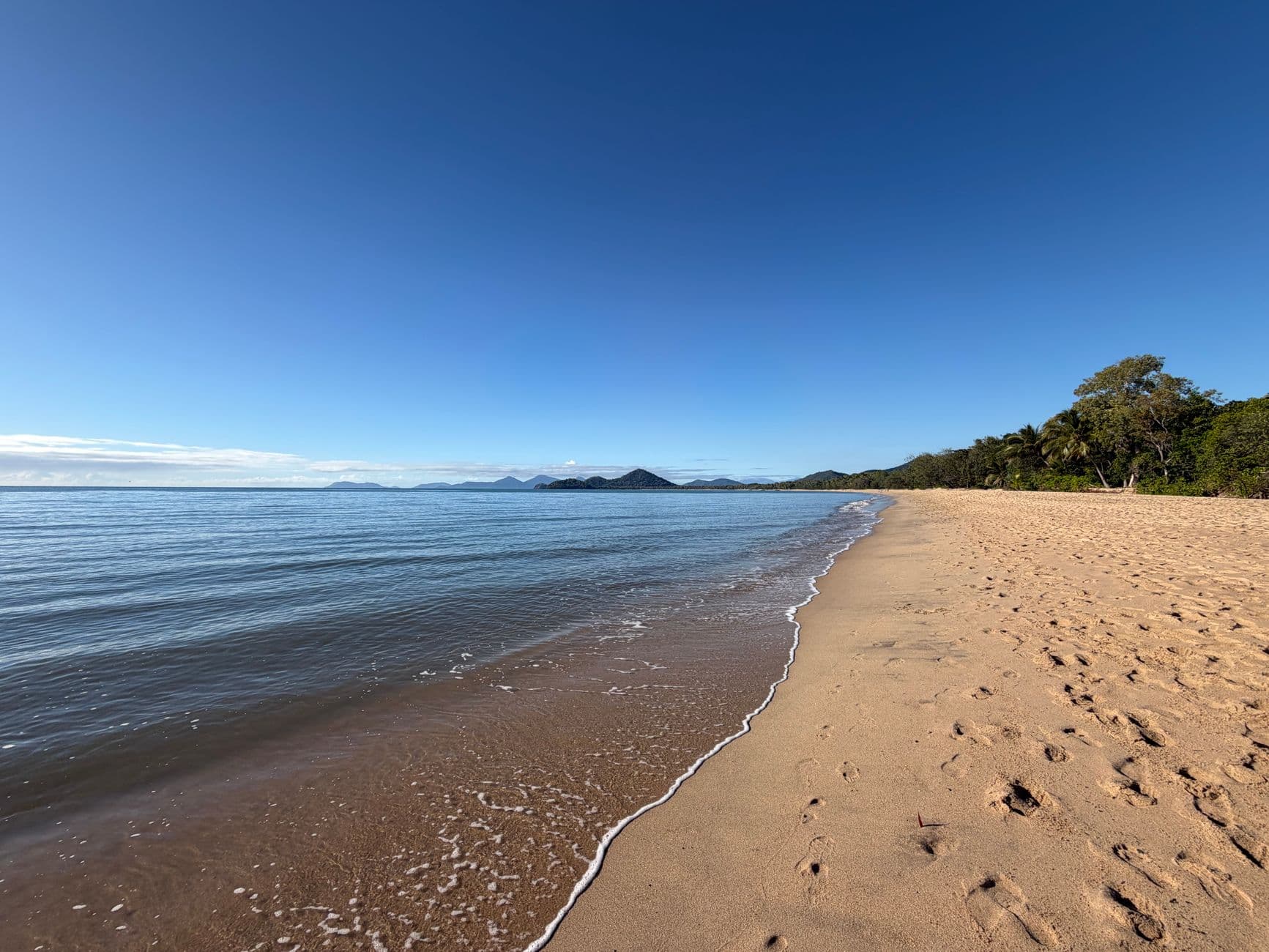
Palm Cove near Cairns. This photograph illustrates the destination setting, not typical seasonal weather.
June to August are the mildest months in the station record. July has the lowest mean maximum and minimum temperatures, while August has the lowest mean rainfall and fewest days with at least 1 mm.
This period is the clearest starting point when lower historical rainfall, milder days and cooler nights matter most. It is still tropical coastal weather rather than a promise of an uninterrupted dry spell. Rain can occur, and conditions for a particular reef, beach, road or rainforest visit still need a current check.
Spring in Cairns
Spring moves from the low-rainfall September record towards warmer late-year conditions. Mean maximum temperatures rise from 28.2°C in September to 30.8°C in November, while mean rainfall rises from 34.8 mm to 87.9 mm.
November also begins the official Australian tropical cyclone season. That calendar change provides a reason to monitor official information; it does not predict that November travel will be disrupted.
What does the wet season mean for a holiday?
It means accepting more uncertainty in the daily plan, not assuming the holiday disappears under continuous rain.
Historical monthly rainfall does not reveal whether rain arrived in short bursts, longer periods or a mixture. It also cannot tell you what will happen during a future week. Use it to decide whether the wetter climate pattern suits you, then switch to current information closer to travel.
A practical wet-season plan keeps weather-sensitive experiences movable until their provider details are confirmed. Check the specific park rather than a general regional label, and check marine forecasts and operator advice for reef travel. Build in some sheltered downtime, but do not treat every outdoor activity as unavailable by default.
The same discipline applies in the drier season. A lower historical average is useful context, not permission to ignore a forecast, warning or closure.
What about tropical cyclones?
The official Australian tropical cyclone season runs from 1 November to 30 April. Activity varies substantially from year to year, and tropical cyclones can occur outside the formal season.
Those facts provide regional safety context; they are not odds for an individual booking. Avoid turning the season into either alarm or reassurance. Before and during travel, check current Bureau of Meteorology forecasts and Queensland warnings, follow official advice and confirm arrangements with relevant providers.
If severe-weather flexibility is especially important to you, make it part of the date and booking decision. That is different from claiming a cyclone is likely to affect your trip.
When should you visit Cairns?
Use your priorities to narrow the calendar:
For milder, historically drier conditions: begin with June to August, then compare the monthly figures and your tolerance for cooler mornings.
For tropical warmth: the late-year and early-year months are warmer, but come with a wetter, more humid planning context.
For a transition period: May and September sit closer to the edges of the mildest, driest part of the record, while March and April remain much wetter.
If you are comfortable with wet-season variability: summer can remain in consideration, provided important outdoor plans stay flexible and current advice is checked.
If one weather-sensitive activity is the purpose of the trip: choose dates only after understanding that activity's current operating, marine or access requirements. Climate cannot guarantee it.
There is no universal winner. The most useful month is the one whose historical pattern fits your priorities while leaving room for the actual forecast.
Planning where to stay?
Once the broad season suits you, compare Cairns accommodation areas against the activities you intend to prioritise. Weather may make sheltered downtime, transport resilience and proximity to confirmed departure points more important, but it does not make one area universally better.
The Cairns Aero records have different available-year counts by measure. Use the Bureau for current forecasts and warnings, and recheck park and provider status close to travel.
Cairns Travel Guide
Continue planning your Cairns trip
Move between the published Cairns guides without losing your place in the planning process.
Next step
Choose your season, then compare stays
Once you know which conditions best suit your plans, compare current Cairns accommodation for your dates.
Check Cairns accommodation
Choose future dates to compare current accommodation pricing and availability through Expedia.
You’ll continue to Expedia to see its current pricing and availability.